Natural Stone vs Reconstituted Stone: Pros, Cons & Which to Choose
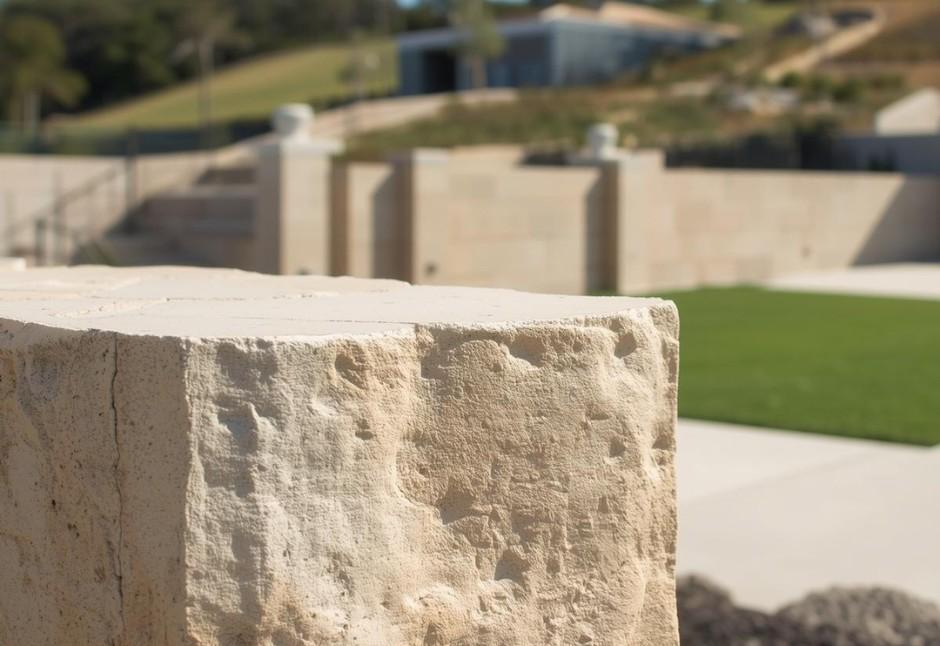
If you are building or renovating in Perth, you may have encountered Tamala limestone.
Maybe it is your neighbour’s retaining wall or those beautiful cream-coloured pavers at the local café that caught your eye.
But what makes this WA stone so special? And why do landscapers and builders swear by it?
This article examines why Tamala limestone often becomes the preferred choice when it comes to construction and landscaping around Western Australia.
What Is Tamala Limestone?
The rock was formed during the Pleistocene era (approximately 2.6 million to 11,700 years ago). Coastal winds heaped up shell fragments and quartz sand into huge dunes along the Western Australian coastline. Water percolated through the material, dissolving lime, which acted as a natural cement, binding all this mass firmly together.
The result is a sedimentary rock known as calcarenite, which extends for more than 1,000 kilometres along our coast.
The Department of Biodiversity, Conservation and Attractions describes this wind-deposited limestone to consist mainly of shell fossils and quartz sands from ancient sand dunes formed on ridges more or less parallel to the coast. In some places, such as the Zuytdorp Cliffs, this limestone reaches a height of 250 metres.
The Pinnacles Desert near Cervantes provides an excellent example. Those distinctive limestone spires demonstrate thousands of years of weathering.
Why Perth Builders Favour This Material
There is a reason Tamala limestone features prominently in residential gardens and commercial buildings all over Perth. Apart from its aesthetic appeal, there’s more to it.
It’s Locally Sourced
This matters more than you’d think. You can reduce transport costs and carbon emissions when you source your building material locally in Western Australia.
Plus, there’s something satisfying about using stone that has been part of our landscape for millennia.
The two main types are Carabooda limestone from the Wanneroo and Yanchep region, and Moore River limestone from around Guilderton. Carabooda limestone tends to be creamier and slightly denser. Moore River limestone is darker and more textured.
It’s Highly Versatile
Tamala limestone can be cut and shaped for diverse applications. The stone has a fine to medium grain structure that makes it relatively simple to work with, yet it’s still strong enough for structural applications.
Whether you need blocks for a retaining wall, bricks for cladding or pavers for your outdoor entertaining area, this limestone suits them all.
Since 1991, companies such as Meteor Stone have been quarrying and processing this material. Their range includes coarse “quarry cut” finishes to fine “diamond cut” finishes.
Thermal Properties Are Excellent
Limestone acts as a natural thermal battery. It absorbs heat during the day and releases it gradually when temperatures drop, moderating temperature fluctuations.
This thermal mass effect can reduce the need for mechanical heating and cooling throughout the year. During Perth’s hot summer months, the stone absorbs daytime heat, helping to keep interior spaces cooler.
In winter, it does the opposite – keeps warmth inside and releases it slowly.
Fire Resistance
Fire resistance has become an increasingly important consideration in Australia and has made all of us think about what we demand from our buildings. Calcium carbonate, the primary composition of Tamala limestone, makes it naturally fire-resistant.
AS 3959 under the National Construction Code deems natural stone (including limestone) a non-combustible material for use in building works within bushfire-prone areas.
Limestone will not support combustion or add fuel to a fire. It gives real protection to your property.
This level of fire protection offers significant peace of mind.
The Practical Aspects: Properties and Performance
Understanding the material properties helps in project planning.
Key Properties:
- Calcium carbonate content: High-purity limestone 70%-95%
- Compressive strength: Average 3.5 MPa, adequate for most uses
- Colour range: From cream to off-white, goes with almost any design scheme
- Mohs hardness: 3-4, soft enough to cut, hard enough to survive
- Workability: Easy workability into blocks, bricks, slabs or bespoke carvings
Its relative softness is actually an advantage. It keeps fabrication costs in check while still delivering the structural performance you need.
The neutral colour palette makes limestone compatible with most design schemes, whether you’re going for coastal contemporary, classic Australian or ultra-modern designs.
Where Can You Use It?
Versatility is one of the main selling features of Tamala limestone.
This means that whether someone wants roughly hewn blocks for a retaining wall, accurately cut pavers for an outdoor entertaining area or sleek cladding panels for building facades – all from the same natural stone – it can be shaped and finished to suit virtually any application.
- Exterior Cladding
Limestone cladding provides an attractive building facade. You can choose either a textured quarry-cut finish or a smooth diamond-cut finish.
Sleek and weather-resistant, low maintenance, and develops a beautiful natural patina over time without any structural degradation.
- Retaining Walls and Feature Walls
For sloping blocks, limestone blocks create effective retaining walls. No two limestone block walls are ever the same due to subtle differences in colour and texture from one block to another.
A limestone feature wall adds visual interest in an outdoor living area.
- Paving and Outdoor Surfaces
Limestone pavers are suitable for patios, driveways, pool surrounds, and walkways. They remain relatively cool underfoot even in the summer heat, are slip-resistant with the correct finish and they age well.
Limestone does not simply deteriorate over time; it becomes better looking as it weathers naturally.
- Interior Applications
Limestone is not restricted to the outdoors. Limestone tiles make excellent hallway floorings, kitchen backsplashes, and bathroom features.
Sealing is recommended to prevent staining and water damage in high-moisture areas.
The Weathering Question
Weathering is a valid consideration. Is limestone subject to weathering? Yes. Does it matter? In most cases, the impact is not as significant as one might anticipate.
What to expect:
- Natural porosity: Limestone is capable of absorbing water, but Perth’s climate doesn’t experience harsh freeze-thaw cycles.
- Surface weathering: A slight patina may develop on the stone, colour can change very slightly or noticeably more in some areas, and superficial erosion may be noticed
- Structural integrity: The weathering is mostly cosmetic – it doesn’t affect the stone’s strength
- The aged look: Many people actually prefer this lived-in, established appearance that develops over time
Protecting your investment:
Sealing can slow weathering. Hydrophobic treatments make the surface water-repellent; moisture can hardly get through, but the stone “breathes”. This reduces salt efflorescence (the white chalky deposits) and keeps your limestone looking new long after installation.
The Environmental Angle
In an age in which sustainability actually matters (and where clients increasingly care about the environmental impact of their building choices), locally sourced Tamala limestone ticks a lot of boxes. It is naturally abundant along our coastline.
Quarrying operations are well established and regulated. Transport distances are minimal compared to imported stone. The energy requirement for limestone extraction and processing is quite low, relative to manufactured alternatives.
Furthermore, the thermal mass properties contribute significantly to the building’s performance. That means reduced energy consumption for heating and cooling over the building’s lifetime. The environmental benefits compound over decades.
Installation Considerations
Proper installation requires consideration of several factors to ensure the correct application of Tamala limestone.
- For paving: Emphasise base preparation. Provide a well-compacted sub-base with adequate drainage. Where foundations are inadequate, limestone may shift or crack.
- For wall cladding: Ensure there is provision for drainage and air circulation behind the stone. This prevents moisture from being retained that could result in problems later on.
- Joints: Choose either 10mm or 20mm joints according to product specifications. Use a good mortar compatible with limestone – some of the new adhesives do not work well with natural stones.
Get these basics right during installation, and your limestone will perform perfectly for decades.
If you are not confident enough to take it up yourself, it’s worth getting someone who has worked with natural stone before – proper installation is an upfront investment that pays off massively down the track.
Maintenance: Less Drama Than You’d Think
Low maintenance is one of the main features of limestone. When installed correctly, maintenance requirements are minimal – you don’t have to do anything more.
Maintenance guide:
- Outside: Wash regularly with water and a soft brush (do not use a high-pressure washer)
- Stubborn soiling: Use a pH-neutral cleaner made for natural stone (never use acidic cleaners)
- Sealing: Reseal every few years depending on exposure and wear
- Inside: Clean with products safe for stone; wipe spills promptly
These straightforward maintenance requirements make limestone a practical choice.
Cost Considerations
Is Tamala limestone expensive?
Compared to manufactured alternatives like reconstituted stone or concrete products, it’s competitive. The price varies based on type (Carabooda vs. Moore River), finish (quarry cut vs. diamond cut), and format (blocks, bricks, pavers).
Value Breakdown
- Initial Cost: Competitive with quality manufactured alternatives.
- Lifespan: Centuries – outlasts most building materials.
- Energy Savings: Thermal mass reduces heating/cooling costs annually.
- Maintenance: Minimal – occasional cleaning, resealing every few years.
- Property Value: Increases resale appeal and market value.
- Replacement: None required in typical building lifetime.
What is always missed in the cost comparisons: longevity. This material does not have to be replaced within 10 or 15 years. Properly installed limestone can last for centuries.
Add up all the energy savings due to its thermal properties, low maintenance costs, and increasing property values—the initial investment provides substantial long-term value.
Finding Your Perfect Limestone Application
Homeowners and renovators get a better understanding so they can make informed decisions. Landscapers and garden designers understand new details, while builders learn information for commercial specifications.
Everyone gets the most appropriate knowledge at their level of involvement with Tamala limestone.
Visit suppliers in person if you can. Looking at samples online only tells part of the story.
You have to see the stone, feel the different textures, and understand how light plays across various finishes. Completed projects allow browsing, which helps visualise how the material performs in real-world applications.
Discuss your specific requirements. A good supplier will probe with questions: Is it to be used outdoors? What is the general design aesthetic that must be achieved? Budget – whether this is a high- or low-budget project – and timeline considerations. They should offer solutions based on your needs rather than pushing whatever stock they currently hold.
Why This Stone Keeps Winning
For all these years, Tamala limestone has remained one of the most preferred building materials in Western Australia.
That is not merely a practice carried down from tradition or habit. The material performs well in many different ways.
It ticks all the boxes. Structurally, it performs well. Appearance? Looks good and keeps looking good. Competitively priced from mid-range to premium.
Sustainable. Versatile enough for any application that you can think of. Connects our modern buildings to the ancient landscape they are built on.
Whether you’re putting in a little backyard garden or involved in some huge commercial development, there’s probably a spot where natural Perth limestone fits.
Want to know more about your options? Contact Meteor Stone to discuss how Tamala limestone can work for your specific project.
Related posts


